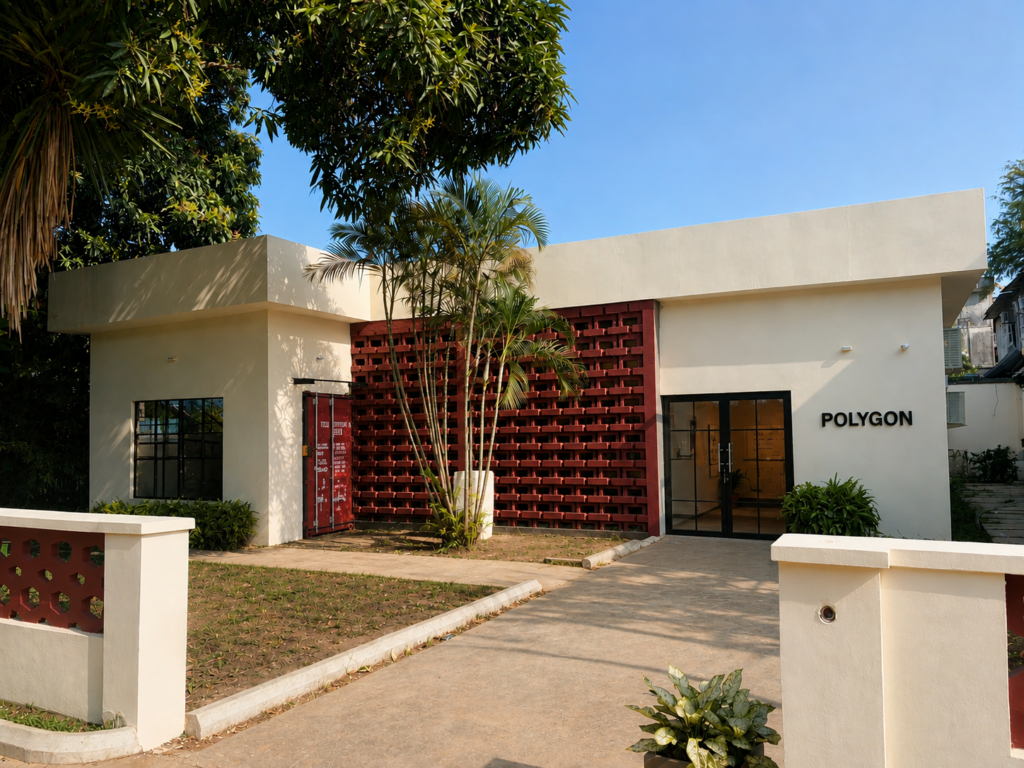
A short drive through Lagos reveals a surprising new landmark. What was once a sterile medical laboratory has been completely reimagined as Polygon’s new creative campus, a space that now pulses with life under the shade of mature trees.
By the time visitors reach Polygon’s new home, few traces remain of its previous life. The building once served as a medical laboratory, but its past is now barely visible beneath a bold, imaginative redesign. Sterile white corridors and clinical rooms are gone, replaced by an atmosphere designed to inspire creativity.
The transformation is a textbook example of adaptive reuse, a practice that breathes new life into structures with history. Instead of demolishing the old facility, Polygon chose to work with the existing shell, turning it into a campus that blends contemporary purpose with organic surroundings. The result is a space that feels both fresh and grounded.
Outside, mature mango and tropical almond trees stand as silent witnesses to the change. Their presence softens the edges of the architecture and connects the campus to the natural rhythm of Lagos. They offer shade and a sense of calm, a deliberate contrast to the city’s relentless energy.
A Space Reimagined
The interior layout has been completely reconfigured to accommodate creative work, collaboration, and community. While the building retains its structural bones, the once clinical interior now hosts studios, workspaces, and gathering areas. It is a place where ideas can take root and flourish, much like the trees outside.
Adaptive reuse is not merely about aesthetics. It is a sustainable approach that reduces the waste and carbon footprint associated with new construction. By repurposing an existing building, Polygon has honored the original structure while giving it a new identity, a move that resonates with a growing global movement toward regenerative design.
The campus is more than a workspace; it is a statement about the possibilities of transformation. For Lagos, a city known for rapid change and creative energy, it serves as a reminder that the old and new can coexist in harmony.
Polygon’s new creative campus stands as a living example of how abandoned spaces can be reborn. What was once a place of white walls and antiseptic corners now hums with creative activity, shaded by mango and almond trees. It is a transformation that speaks to the power of imagination and the potential hidden in forgotten structures.


