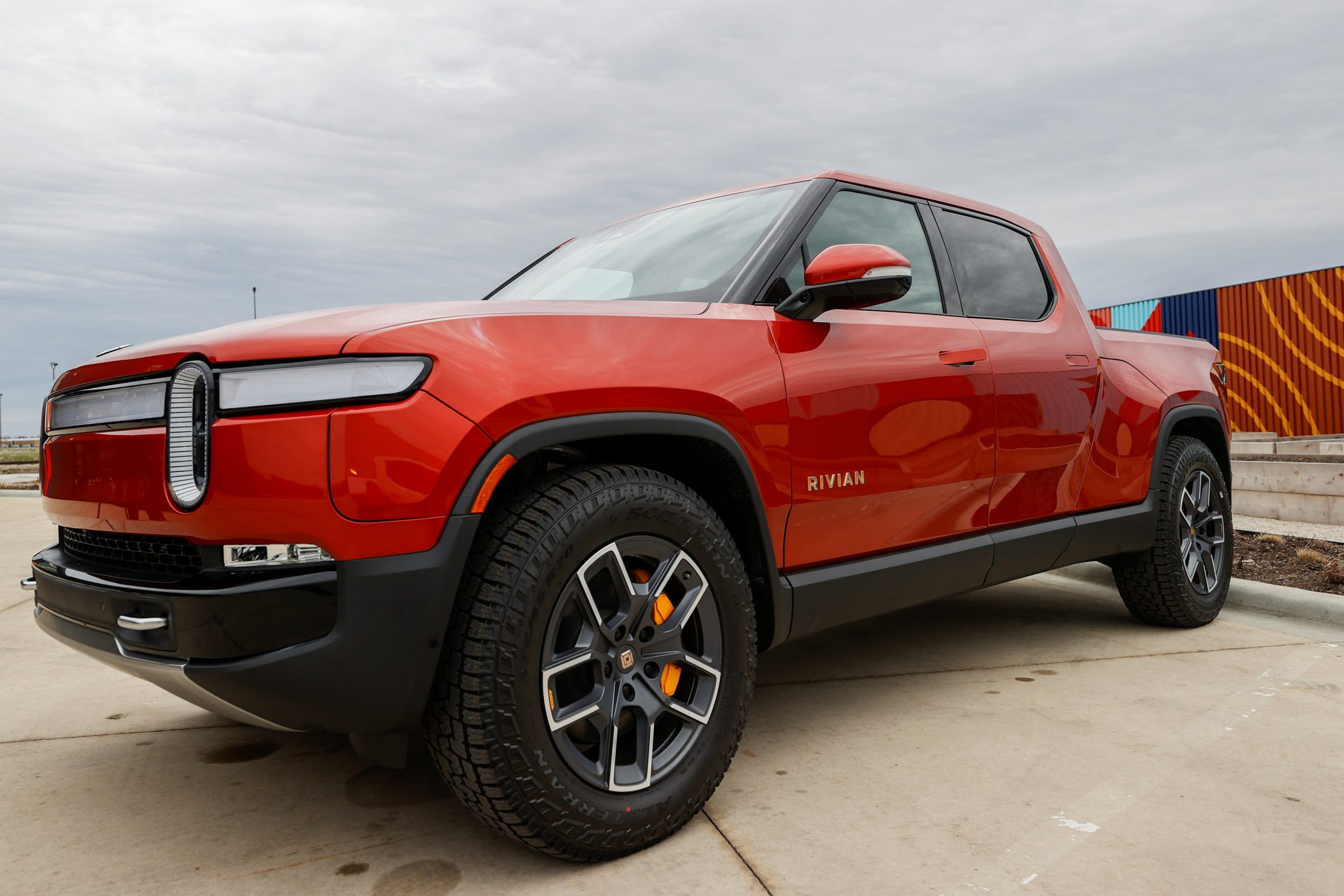
What’s the best advanced driver assistance system on the market? Ask Rivian’s new artificial intelligence and it will tell you its own creation is the winner. During hourslong drives in an R1T pickup truck on several Midwest highways, the chatbot declared Rivian’s system ‘truly exceptional’ and ‘an unmatched blend of safety and technology.’ But while that AI might be biased, Rivian’s broader ambition is clear: catch up to Tesla’s Full Self-Driving (Supervised) and eventually surpass it, while adding safety guardrails Tesla doesn’t use.
After logging hundreds of miles in both systems, it’s evident that Rivian’s Autonomy+ has moved past legacy competitors like General Motors’ Super Cruise on highways. However, for nonhighway driving and point-to-point journeys, Tesla’s FSD still holds the edge. Rivian plans to introduce point-to-point driving later this year, and its current system represents a major leap from what it previously offered.
“That’s the next step,” said James Philbin, senior vice president of autonomy and AI at Rivian. “Tesla’s system you use is a point-to-point system. So that that’s the next big leap for us in a way, is getting to that same point-to-point type interaction and that system where it really does the full driving task.”
No vehicle on sale today is fully self-driving or autonomous. Drivers must always pay attention and be ready to take over. These advanced driver assistance systems (ADAS) control speed, braking, and steering using cameras, sensors, and map data, with an increasing number allowing hands-free operation.
Rivian attributes its progress to vertical integration, including a new generation of software and vehicle architecture. The company is just beginning to benefit from that investment. Analysts also see ADAS as a growing revenue stream. “We favor self-reliant (and properly-valued) companies that are building next-gen machines using in-house expertise,” Piper Sandler analyst Alexander Potter said in an investor note upgrading Rivian’s stock last month. “As volume rises, Rivian should be better able to monetize software & services, a key benefit of vertical integration.”
The systems come with different price tags. Tesla’s FSD (Supervised) costs $99 per month, according to its website. Rivian charges $49.99 monthly or $2,500 for the vehicle’s lifetime. GM’s Super Cruise is $39.99 per month or $399 per year.
The biggest operational difference lies in handling nonhighway roads with traffic lights and signs. Rivian’s system detects these signals and alerts the driver but doesn’t act on them. Tesla’s FSD, by contrast, handled every signal, interchange, and exit ramp during nearly 200 miles of driving in rural Michigan and downtown Ann Arbor.
Having tested hands-free systems for a decade, I can say these two are by far the most advanced. That wasn’t always the case. GM led with Super Cruise, which I first tried a year before its 2017 debut. But GM was slow to roll it out or expand capabilities beyond highway use and lane changes. Ford quickly matched GM on highways, but both automakers still lack hands-free nonhighway driving, with such capabilities expected around 2028.
Tesla’s system demonstrated remarkable competence in my 2025 Model Y. For hours and dozens of miles, it controlled the vehicle without intervention on both highways and city streets. It navigated traffic circles, parallel parked, handled a semitruck blocking half a lane on a two-lane road, and made its way through complex construction zones, sensing every barrel or cone.
Tesla’s in-vehicle Grok AI explained the challenge: “Highways have predictable lanes, speed, fewer pedestrians and clear markings, making sensor fusion and path prediction simpler. City streets bring chaos, intersections, bikes, peds, construction and ambiguous rules that challenge even top AI vision systems.”
Rivian’s technology performed very well on highways, with no interventions except at exit ramps and in some construction zones. It still cannot change lanes on its own, a feature the company says is coming soon. When asked about my experiences, Rivian said its vehicles can detect construction objects but don’t always display them on the screen, and the system may need assistance in places like roundabouts.
All ADAS systems, except for a Mercedes-Benz system in limited circumstances, require driver supervision. The rise of hands-off technology has prompted concerns about inattentiveness. Automakers have added driver-facing cameras, but worries remain about the handover from system to human and about over-reliance. YouTube is filled with examples of misuse, particularly with Tesla, as well as videos showing both impressive moves and failures.
There is also little regulation governing these systems, with each company taking a different approach. Rivian’s Philbin says the company aims to exceed Tesla’s capabilities through a more robust sensor stack. “We’re actually a big believer in multimodal imaging, so cameras and radars, and later on, early next year, lidar as well on the R2,” he said.
Rivian’s system uses at least 10 high dynamic range cameras, five radars, and some map data. It also plans to add lidar, which improves a vehicle’s ability to detect objects. Tesla relies solely on cameras and a vision-based setup that critics say isn’t robust enough in certain conditions. The National Highway Traffic Safety Administration earlier this year escalated a probe into Tesla’s FSD after identifying crashes, including a fatal incident where the system failed to alert drivers about reduced visibility from sun glare or fog. Philbin said lidar can better detect hazards in such conditions. My test drives took place on clear days without inclement weather.
Despite having fewer sensors, Tesla’s Grok chatbot, developed by Musk’s xAI (which merged with SpaceX earlier this year), also claimed superiority. “Tesla’s Full Self-Driving (Supervised) is widely rated as the top advanced driver assistance system in 2026 by sources like Motor Trend and others,” it said. It added that “Rivian’s AI Assistant is solid for voice controls, navigation, and vehicle features in their R1 vehicles, but it’s still catching up to more advanced systems like ours and full self-driving capabilities.”
Rivian’s progress is undeniable, but Tesla remains the benchmark for now. With point-to-point driving on the horizon, Rivian intends to close that gap. Whether it succeeds will depend on how well its safety-first approach resonates with drivers.