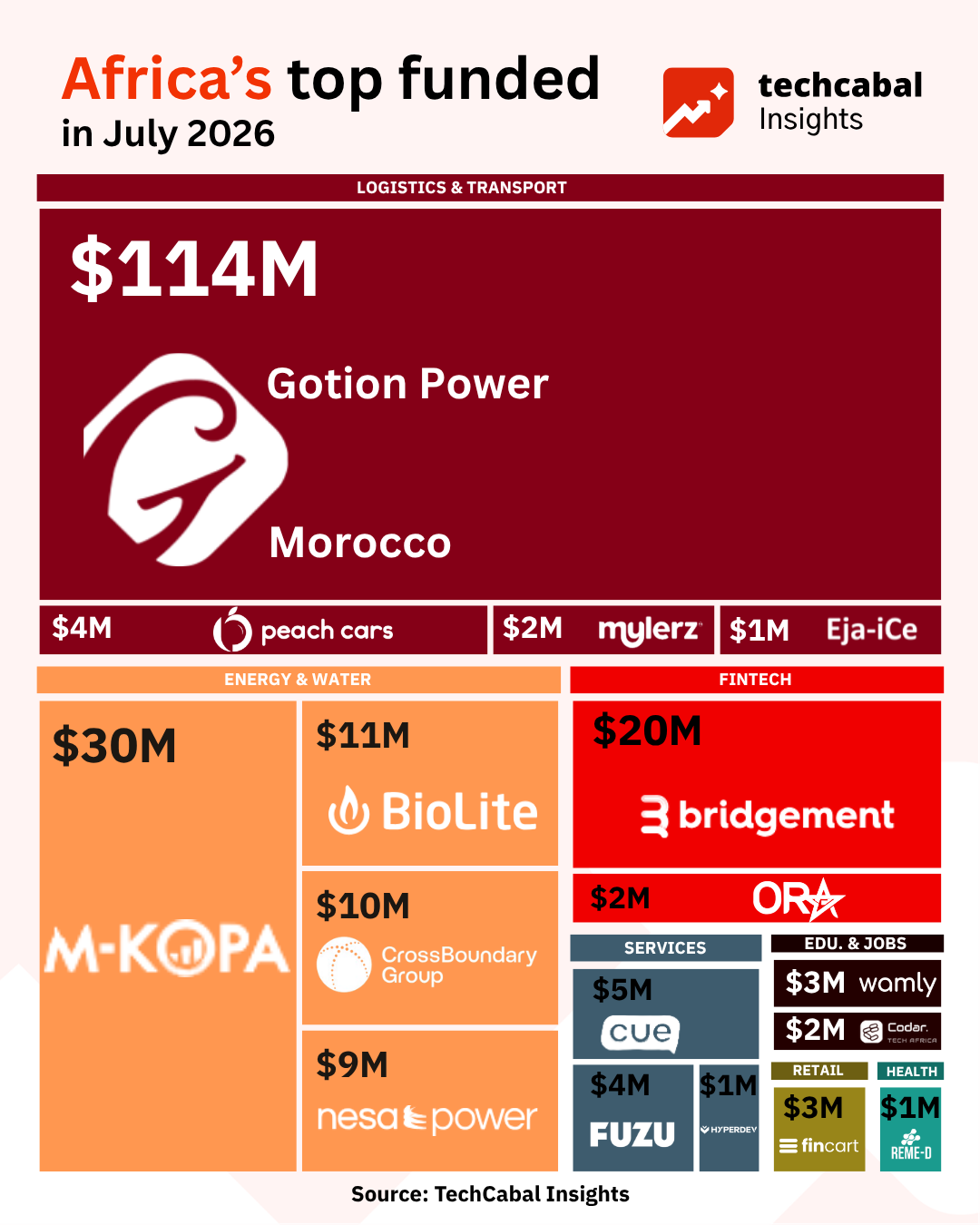
African startups started the second half of 2026 with a $224 million funding injection in July, nudging the year’s total to $1.66 billion. The latest figures show a marked shift toward clean energy, electric mobility, and larger debt packages.
The July haul came in below June’s $334 million, but the distribution of capital was more telling. Clean energy, electric vehicles, and physical infrastructure absorbed the bulk of the money raised across the continent.
In all, 37 deals were tracked during the month. Financial details were disclosed for 28 of them, while nine startups kept their funding amounts private.
Capital moved across a spectrum of sectors, from clean energy to fintech expansion and AI platforms.
Two standout transactions stood out: Gotion Power Morocco secured $114 million for a gigafactory, and M-Kopa closed a $30 million debt facility. These deals are viewed as markers of a broader pivot toward commercial EV adoption.
TechCabal previously highlighted Swap, a Nigerian startup that converts petrol-powered commercial tricycles, known as kekes, into electric vehicles with swappable lithium batteries. While operators save on fuel and maintenance, Swap and similar companies must contend with the high price of charging infrastructure in regions with unreliable power grids.
As gigafactories such as Gotion scale up and fleet funders including Spiro, MAX, and Swap grow, the prospects for African EV expansion rest heavily on local battery manufacturing and charging networks. Capital is increasingly flowing to startups that can keep batteries charged affordably at ground level.
Debt proved the dominant funding method in July, comprising 75.2% of all capital raised, or $168.55 million. That trend points to mature African companies borrowing money rather than surrendering equity. It also underscores a strategic shift, with founders channeling funds into heavy physical infrastructure: gigafactories, solar installations, and vehicle fleets.
Consolidation continued apace as well. After a historic first half of 2026 marked by 63 mergers and acquisitions, July alone recorded 13 new M&A deals. Larger players are acquiring smaller competitors to expand their reach, gain technology, or secure valuable licenses.
Looking forward, regulation is set to shape the next phase of ecosystem development. Across Africa, authorities are tightening rules on data protection and digital assets. As these laws gain enforcement power, startups will need to increase spending on local cloud infrastructure, cybersecurity, and compliance measures to operate smoothly across borders.
The confluence of debt financing, EV infrastructure development, and regulatory adaptation is redefining how African startups raise and allocate capital.