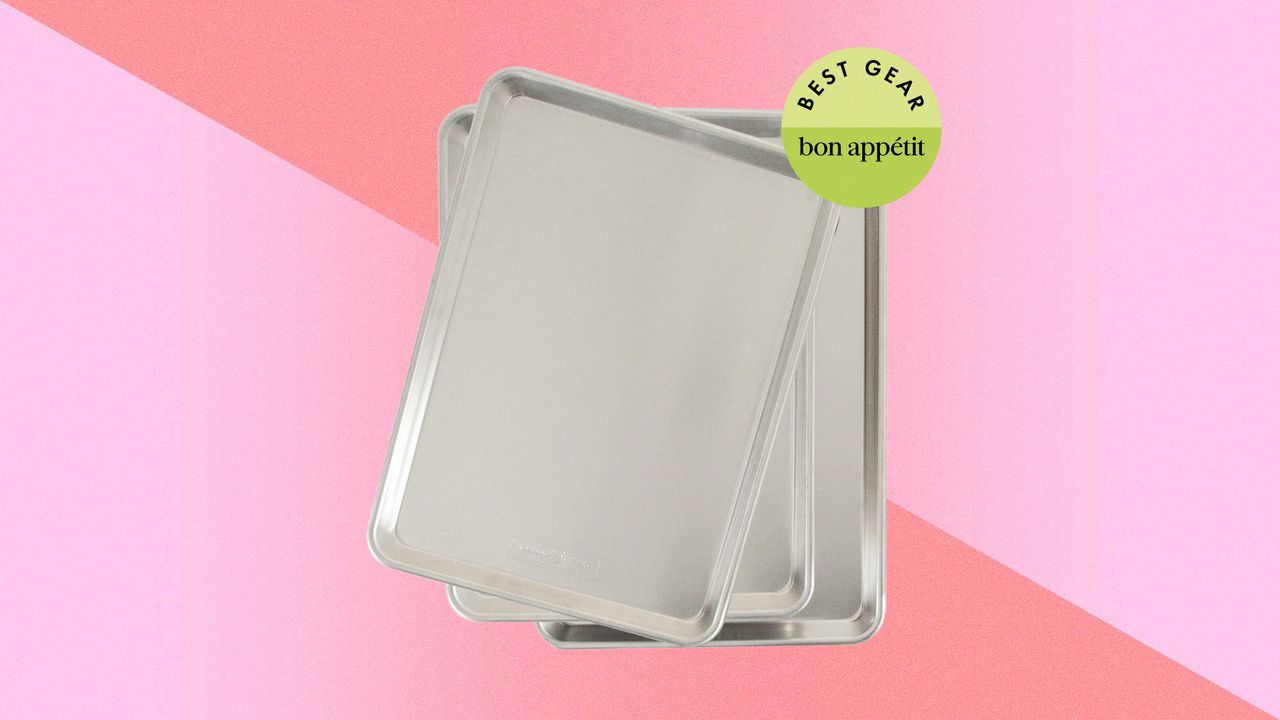
After putting 16 baking sheets through high heat, messy dinners, and repeated washes, the Nordic Ware Natural Aluminum Half-Sheet came out ahead. It delivered even browning, resisted warping longer than the competition, and cost far less than many pans that performed worse.
New in this update: I’ve added testing information on nonstick baking sheets and an explanation as to why my team doesn’t recommend them.
The best baking sheet overall
Nordic Ware Natural Aluminum Half-Sheet. The pan is made of 20-gauge aluminum and measures 18 by 13 inches, the standard half sheet size. It weighs 1.6 pounds.
After several rounds of testing, this Nordic Ware pan stood out as the best of the group, and it also happens to be one of the most affordable. That combination of quality and value earns it the top spot.
The rolled edges help the pan resist warping when exposed to high temperatures. Most sheet pans eventually bend, but the Nordic Ware stays flat for longer than its competitors. When it does warp, it tends to bulge in the middle rather than fold in on the sides, which makes it easier to work with.
We generally try to avoid recommending products that you’ll have to replace. But aluminum is one of the easiest and most efficient materials to recycle on earth, so I think it’s okay here.
What I’d leave: The surface of this aluminum sheet pan will stain and discolor over time, though this won’t affect the quality of your food and isn’t a reason to replace the pan. The warping that inevitably happens after several years of consistent use, however, is your sign to recycle the old pans and get a new pack.
To extend your sheet pan’s lifespan as long as possible, hand wash it rather than putting it in the dishwasher, as the machine’s heat and detergent will wear away at the surface.
How I tested baking sheets
My testing process involved several steps. First, I placed each pan in a 450°F convection oven for 10 minutes to see if it warped right away. I listened for loud pops or banging sounds, which indicate that the metal is starting to contort under the stress of high heat.
After letting each baking sheet cool to room temperature, I put it back in the 450°F oven and heated it for five minutes. Immediately after removing a pan, I took surface temperature readings from the center and edge, and then did so again every 30 seconds for a total of two minutes. This test reveals how fast a pan heats and cools, and how evenly that heat is distributed across the surface, especially as it dissipates.
I also cooked vegetables and chicken thighs coated in oil in each pan to see how well the sheets browned the food or if they burned it. This test gave me a practical sense of handling and how easy it is to maneuver the pan in and out of a hot oven.
Finally, I hand washed the pans with soap and water to see how easy they were to clean.
Alongside this hands-on testing, long term anecdotal experience and recommendations from our Test Kitchen editors and industry professionals helped inform the final decision.
Then there are tri-ply stainless steel baking sheets. These feature a layer of aluminum sandwiched between two layers of stainless steel. While this configuration of metals is great for pots and pans due to the greater control it provides over direct heat, it makes for a baking sheet that is slower to heat and cool. In our tests, my team has found that, when following written recipe cook times, baked goods baked on stainless steel sheets are consistently undercooked. That’s because the vast majority of recipes using a baking sheet were written and tested using aluminum baking sheets.
Factors I evaluated
Good baking sheets shouldn’t warp, so I looked for design features that aimed to prevent that. Rolled edges keep pans from twisting, and a heavier gauge metal can withstand high heat in the oven. The sheet should also be able to withstand scraping from metal utensils, which is another reason why nonstick sheets aren’t so great.
Even though sheet pans eventually give out, the longer a sheet pan can put in time, the better. Durability in the oven is most important, but it’s important to note that cleaning and care factor into a pan’s lifespan just as much. Many sheet pans are technically dishwasher safe, but dishwashers accelerate wear and tear on almost all cookware.
Other baking sheets I tested and liked
Our top pick is far and away the best quality for the price of the bunch. But if you’re drawn to a different brand, know that the following pans will also get the job done.
Made In is nearly identical to the Nordic Ware winner in appearance and performance. It’s a great piece of equipment, and the only reason it isn’t a top pick is that it’s nearly twice the price of the Nordic Ware.
Chicago Metallic Commercial II Traditional Uncoated Jelly Roll Pan: For an aluminized steel pan, this one performed pretty well. Its ability to brown vegetables was on par with the Nordic Ware, but it’s noticeably heavier.
Fat Daddio’s Natural Aluminum Half Sheet Pan, 2 Pack: This pan performed reasonably well compared to our winner. It was easy to clean, but it warped ever so slightly despite its heavier gauge.
Norpro Commercial Grade Jellyroll Pan: This is a very affordable pan. However, it warped quite a bit at high heat, causing the vegetables to cook unevenly.
Artisan Professional Classic Aluminum Half Sheet: For whatever reason, this sheet pan was especially hard to clean. Food stuck on strong to the surface, which made scrubbing it a real pain.
Baking sheets I don’t recommend
One of the weakest pans we tested warped substantially in the oven, producing inconsistent results.
All-Clad Nonstick Pro Release Half Sheet: All love to All-Clad, but this pan wasn’t it. Beyond the Teflon coating, we found the three handles to be a bit awkward.
Nordic Ware Aluminum Nonstick Baker’s Half Sheet: For a nonstick pan, this one wasn’t very nonstick. We love Nordic Ware, but just get the uncoated version.
Another nonstick sheet pan with a Yves Klein blue finish looked great, but the coating was subpar and began to chip after a year of regular use.
FAQs
How do I choose the right size baking sheet for my oven?
Baking sheets come in a variety of sizes: full sheets (26 x 18 inches), half sheets (18 x 13 inches), and quarter sheets (13 x 9 inches). The most commonly used size, and the one ubiquitous in home kitchens, is a half sheet pan. They are just the right size for a standard oven and can easily fit into most kitchen cabinets. It’s the sheet pan that sheet pan recipes are built around, and the BA team recommends every home cook stock their kitchens with a couple. Quarter sheet pans also come in handy for toaster oven baking, serving appetizer spreads, and even doubling as trays to wrangle oils and spices on your counter.
Are nonstick baking sheets better than aluminum ones?
The bottom line: We prefer to recommend cookware that lasts, and while aluminum baking sheets don’t last forever, they can at least be recycled. Coated baking sheets cannot be.
What’s the best material for a sheet pan?
Most chefs and culinary professionals say that heavy gauge aluminum is the best material for a sheet pan. Aluminum heats up and cools down quickly, transferring heat to baked goods within seconds of entering a hot oven. It’s also lightweight and inexpensive.
The alternative is stainless steel, which is significantly more expensive and slower at conducting heat, which can potentially impact overall cooking time. While experienced bakers may find that this is useful in certain cases, such as for fragile, heavily enriched doughs and batters, virtually every recipe you’ll find that uses a sheet pan was developed on an aluminum one.
After all that testing, the Nordic Ware Natural Aluminum Half-Sheet remains the pan we’d recommend for almost any home cook. It performs reliably, cleans up well, and won’t break the bank.