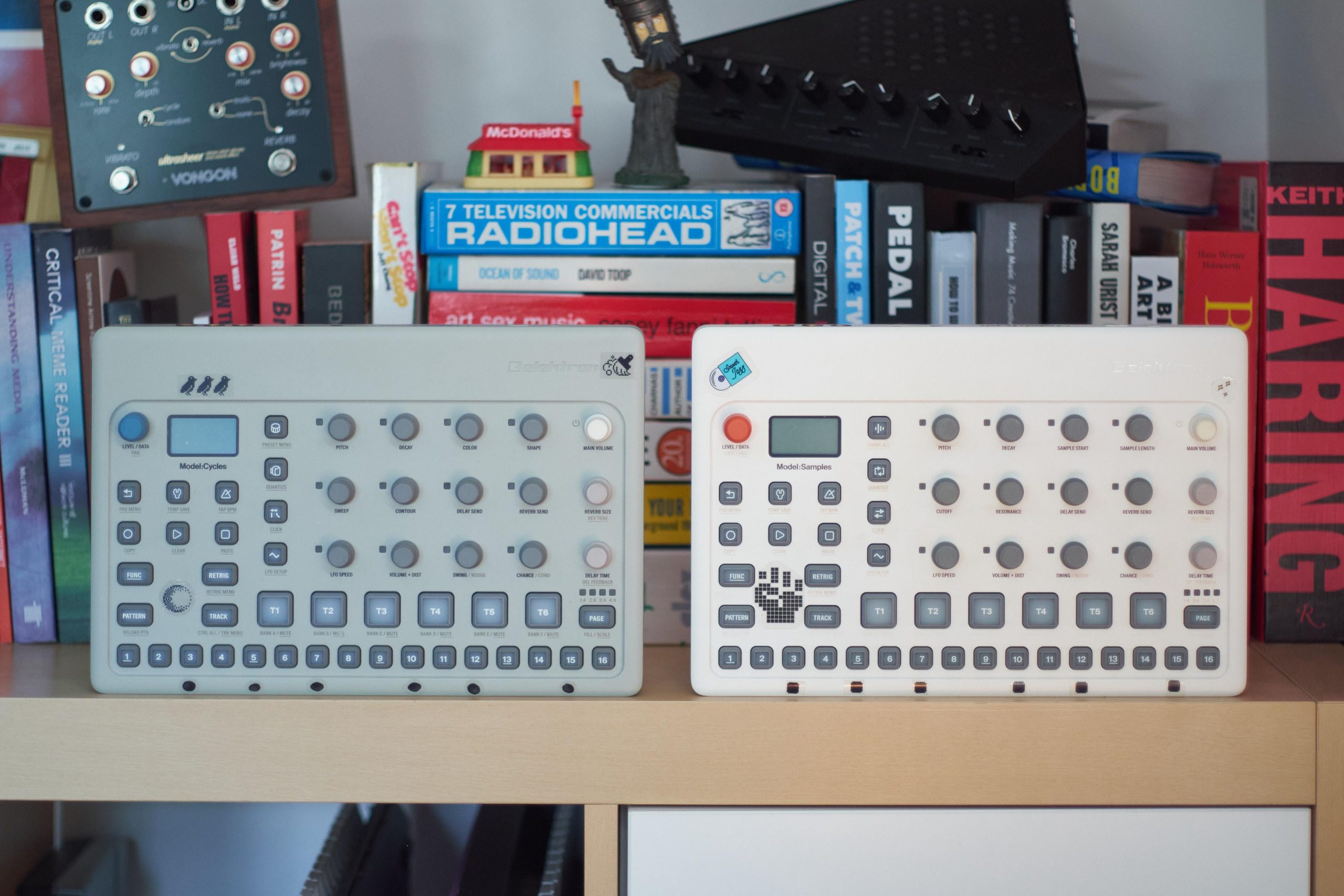
People often ask me what to buy when they want to start making electronic music. My usual answer is Elektron’s budget friendly Model:Samples and Model:Cycles, a pair of grooveboxes that deserve far more attention than they get.
These two machines don’t create the same buzz as Teenage Engineering hardware or the Telepathic Instruments Orchid. They also tend to be overlooked next to Elektron’s own higher end and more niche devices like the Digitakt, Octatrack, and Tonverk. Yet even after I have added fancier and far more expensive instruments to my collection, I keep coming back to the Model series.
First time buyers usually gravitate toward familiar brands such as Korg and Roland. On Reddit, you will often see people recommend the Novation Circuit Tracks, which I personally find confusing and weak sounding. Some of this may also stem from Elektron’s reputation for making gear that is tough to figure out. If you are already an experienced producer and don’t mind a complex workflow, you will probably move toward a more powerful Elektron box like the Digitone or Syntakt. That leaves the Model lineup stuck in an awkward middle position, and that is a shame.
The main difference between the two instruments is that the Model:Cycles uses FM synthesis, while the Model:Samples plays samples, as you might expect. It is not technically a sampler, though, because it cannot record audio. Samples must be loaded over USB.
The Model:Cycles is built around a streamlined version of the engine inside the Digitone, which is one of my favorite sounding synthesizers ever created. This modern take on FM can produce the cold bells and icy pads associated with iconic instruments like the DX7, the definitive sound of the nineteen eighties. It can also handle modern glassy keyboard tones and aggressive EDM bass that harks back to the turn of the millennium.
The two models are more similar than different. Both are six track grooveboxes with six velocity sensitive pads and a generous assortment of knobs for hands on control, and they look almost identical. More importantly, they feature Elektron’s legendary step sequencer without being nearly as intimidating as the company’s more expensive and notoriously complex offerings.
The sequencer revolves around what Elektron calls trigs and locks. A trig is essentially an event, usually triggering a note. A lock is a setting that applies to a specific step. It sounds simple, but this concept makes the instruments far more capable than they might appear at first glance.
Six tracks is not a huge amount of room. Once you load a kick, snare, and hi hat, you only have three tracks left for bass, melodic parts, and extra percussion. Sound locks allow you to change samples or presets on a per step basis. That means, as long as sounds never need to play at the same time, you can put your kick and snare on one track, place hi hats and other percussion on a second track, and leave the other four tracks for everything else. This is just the most obvious example of how locks expand what might seem like a limited setup on paper.
The sequencer can be used as a straightforward step sequencer, where you program a four on the floor kick and a snare on the backbeat. But it grows with you as your skills improve and you want to build more complex tracks. Trig conditions let you set rules that govern when certain steps are triggered. For instance, a step might play only every third time through the loop, only when you press the fill button, or only if a previous trig condition has been met. That means you can pack a huge amount of variation into a single 64 step pattern. You can then chain several patterns together to create complex, evolving arrangements that are simply not possible on most gear in this price range.
The Model boxes are also incredibly fun. Where other Elektron gear requires a lot of menu diving, the Model:Samples and Model:Cycles are immediately approachable and built for live performance. It is easy to trigger a drum fill by pushing a button, tweak a knob to open the filter on a bass, or briefly bathe a lead melody in delay.
The Control All feature might be the most enjoyable. As you might guess, it lets you control all tracks at once. You can bury the entire track in reverb, crank up the distortion, and lower the pitch of all samples to create a mangled, chaotic breakdown. Then you can undo it all instantly by pressing the function and pattern buttons, and drop the beat back in. The Model:Samples and Model:Cycles encourage jamming in a way that a lot of electronic music gear does not, and it is an absolute blast.
To be sure, they are not perfect. The pads are mediocre. Having to load samples over USB rather than recording them directly is a hassle. And the lack of polyphony, meaning each sequencer track can only play one note at a time, is a disappointment. But at $349, it is hard to complain. They can also be found used for as little as $200 on Reverb or Craigslist.
Frankly, these are some of the best bargains in music hardware and a great place to start your journey into producing electronic music.


