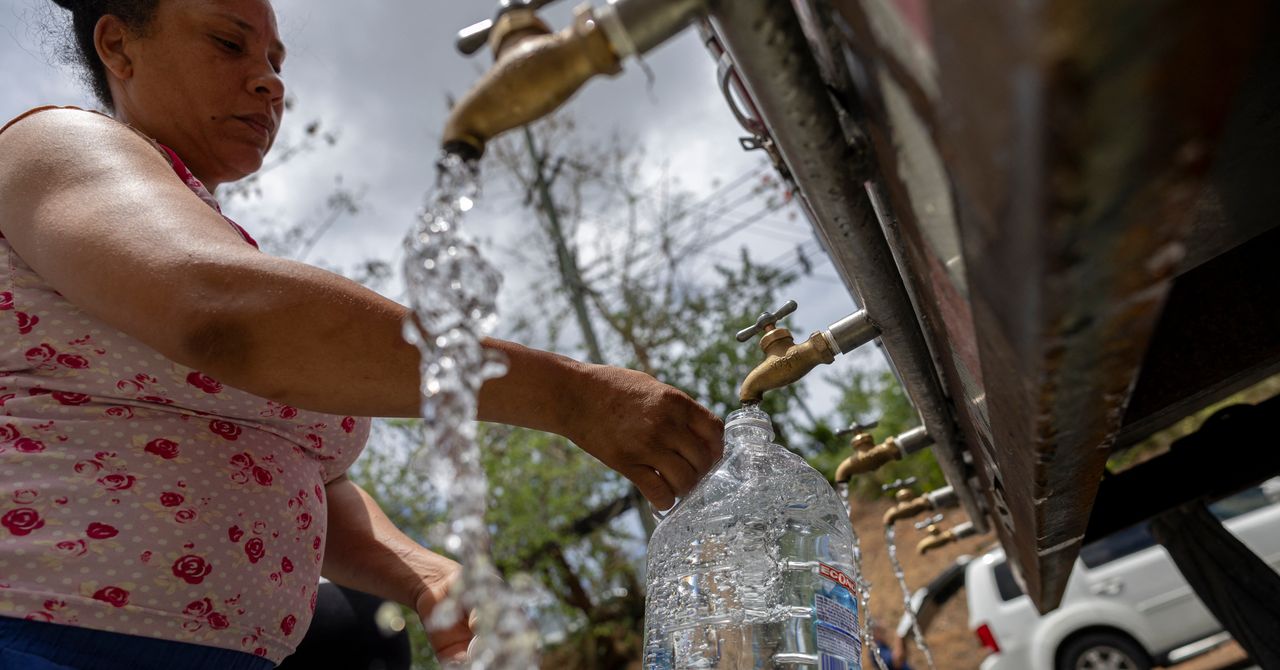
Puerto Rico is rationing water after its driest month on record, a historic drought that has upended daily life for tens of thousands of households. The island receives anywhere from 30 to 169 inches of rain a year, and with climate change expected to bring more intense droughts, some say the key to easing the crisis is falling from the sky.
The emergency has grown more severe in recent days. Over the past week, Governor Jenniffer González ordered municipal governments in the northeast to shut off water for two days at a time, leaving 180,000 households with limited access. Many families have been without consistent water for more than 100 days.
The drought has compounded a water system already strained by broken pipes and outdated infrastructure. Environmental lawyer Ruth Santiago, who works with the Comité Diálogo Ambiental, argues that the real problem is not a shortage of rain but how the government manages the water supply. “Even with the climate crisis and these droughts, we still have abundant water,” she said, as a storm erupted during a conversation. “We could be harvesting rainwater right now.”
Rainwater harvesting works on a simple principle: gutters divert rain from a roof into a storage tank that connects to pipes going to a faucet or shower. Larger installations can supply water for cooling power plants and other industrial uses. “One of the best unused reservoirs of water in Puerto Rico are the roofs of the houses,” said Fernando Abruña, a partner at Abruña & Musgrave Architects and a fellow of the American Institute of Architects. He estimates that if 1 million households collected rainwater, the island could capture 30 billion gallons a year. The average resident uses 62 gallons each day, meaning residential consumption totals roughly 72 billion gallons annually.
The Puerto Rico Aqueduct and Sewer Authority loses about 60 percent of drinking water before it reaches customers, mostly due to leaks. The current emergency has been caused in part by a series of ruptures in the Superaqueduct, a main pipe measuring 72 inches that serves major cities on the northern coast. Santiago says repairing the aging distribution network is the most urgent task, but she adds that rainwater harvesting is a cost effective and quickly implemented solution.
Other island communities have long embraced the practice. In the US Virgin Islands, around 90 percent of homes have cisterns, and building codes often require new developments to include such systems. Barbados has similar requirements, and Honolulu County offers free rain barrel installations on a limited basis. In Puerto Rico, however, the practice is not widespread, as the government has prioritized centralized grids fed by freshwater. There is no mandate that residents install catchment systems, and the government offers no incentives.
“There is nothing that can help the Caribbean region as quickly and as reliably as rainwater harvesting,” said Farah Nibbs, an assistant professor at the University of Maryland Baltimore County’s Department of Emergency and Disaster Health Systems. She argues that governments should treat the practice “as part of the national water supply” and help cover costs so that households do not shoulder an unfair burden.
That leaves the work to small organizations. Plenitud Puerto Rico, a nonprofit in Las Marías, has installed 73 rainwater harvesting systems since 2010. Executive codirector Owen Ingley puts the cost at $500 to $2,000 for simple units and up to $5,000 for larger ones with electric pumps. Maintenance and water quality monitoring add to the expense. The group recently helped a man in his eighties who lives alone and faces frequent water cuts. The system does not provide drinking water, but it allows him to flush his toilet and fill his dog’s bowl. “He’s a really sweet and talkative guy with gray hair and a big smile,” Ingley said.
On the political front, José Pérez Cordero, an at-large member of Puerto Rico’s House of Representatives, introduced a resolution in June that would order the Puerto Rican Natural Resources Committee to conduct a feasibility study on rainwater harvesting, including how other Caribbean islands have made the practice work. The measure has not advanced. A 2024 law requiring public agencies to install rainwater collection on government buildings has also gone unenforced. Pérez Cordero, whose New Progressive Party is in power, said his colleagues have lacked the political will to act proactively. “We are, right now, in the perfect moment to do it, because we are in the middle of a crisis,” he said. “Sadly, we always wait for the reaction.”
Rainwater harvesting cannot solve every problem. Urban apartment complexes offer little space for tanks, and the systems depend on a rainy wet season, which climate change may make less reliable. Even so, they could help patch a system in urgent need of support.
As Pérez Cordero put it, “Facing climate change, every year is going to be harder. Every year, the dry season is going to be longer. Every year, the rainy season is going to be harder too.”