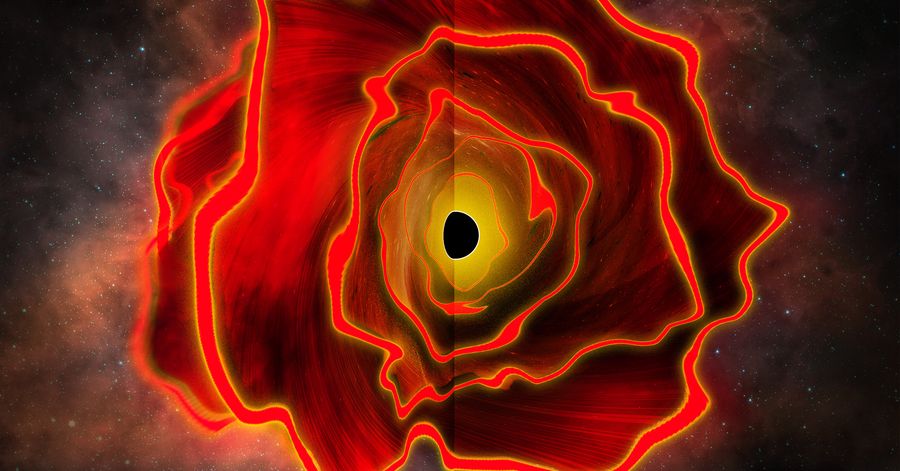
A mysterious object that appears as a bright red dot in the early universe could be a ‘black hole star,’ a hypothetical structure in which a black hole is concealed by a dense shell of gas, according to a new study published in Nature.
In a new paper appearing in the journal Nature, researchers have chronicled a ‘black hole star’ that stretches across a region as large as our solar system and glows a deep red in the distant reaches of space. The observations come from the James Webb Space Telescope, which continues to reshape how astronomers view the cosmos.
The team focused on some of the most distant phenomena ever observed, objects that look like stars but may actually be something else entirely. Based on the light they emit, these objects share certain qualities with giant stars, yet astronomers suspect they are black holes masked by incredibly dense and luminous gas.
These hypothetical objects have been named black hole stars, and the new research, published Wednesday, offers the strongest case yet for their existence.
The signal at the heart of the study dates to a time when the universe was just 660 million years old, compared with its current age of roughly 14 billion years. In the James Webb Space Telescope’s images, the object appears as one of the many bright, reddish spots the telescope has uncovered in the early universe.
Seen from billions of light-years away, this phenomenon resembles a colossal star. But the object, designated MoM-BH*-1, has unusual features. It emits about 100 billion times more energy than any star could produce through nuclear fusion, according to the research team, making it extraordinarily bright even by the standards of the early universe.
Another peculiarity is that part of its light suddenly vanishes. Stars can create a similar signal when their atmospheres absorb specific wavelengths, but in MoM-BH*-1, the absorption is far too pronounced to be explained by ordinary stellar behavior. The researchers believe that a vast amount of extremely dense gas is responsible for swallowing that light.
These clues led scientists to the black hole star hypothesis. At the center of MoM-BH*-1, a black hole would be devouring matter and releasing enormous amounts of energy. Around it would be a massive gas envelope. The energy would pass through that gas before escaping into space, acquiring some of the characteristics we typically associate with starlight in the process.
The hypothesis could also shed light on another puzzle uncovered by the James Webb Space Telescope. The telescope frequently finds small red spots in the early universe whose origins are unclear. They don’t fit neatly into the known categories of deep space objects. Astronomers have offered several explanations, including that these are compact galaxies packed with stars, black holes hidden behind dust, or entirely unfamiliar systems. Black hole stars are among the possibilities.
MoM-BH*-1 is of particular interest because, unlike other red spots, its black hole seems to almost completely hide the surrounding galaxy.
“Every little red dot is consistent with being a black hole star, embedded in a generic early galaxy. But what is special about MoM-BH*-1 is that the black hole star is essentially completely outshining its surrounding host galaxy, such that we’re seeing pure black hole star light,” says Rohan Naidu, the study’s lead author who performed the work while at MIT, in a press release.
While the black hole star hypothesis remains one of several possibilities, the new observations give astronomers their strongest evidence yet that these exotic objects may be real, and offer a promising explanation for the red dots scattered across the early universe.