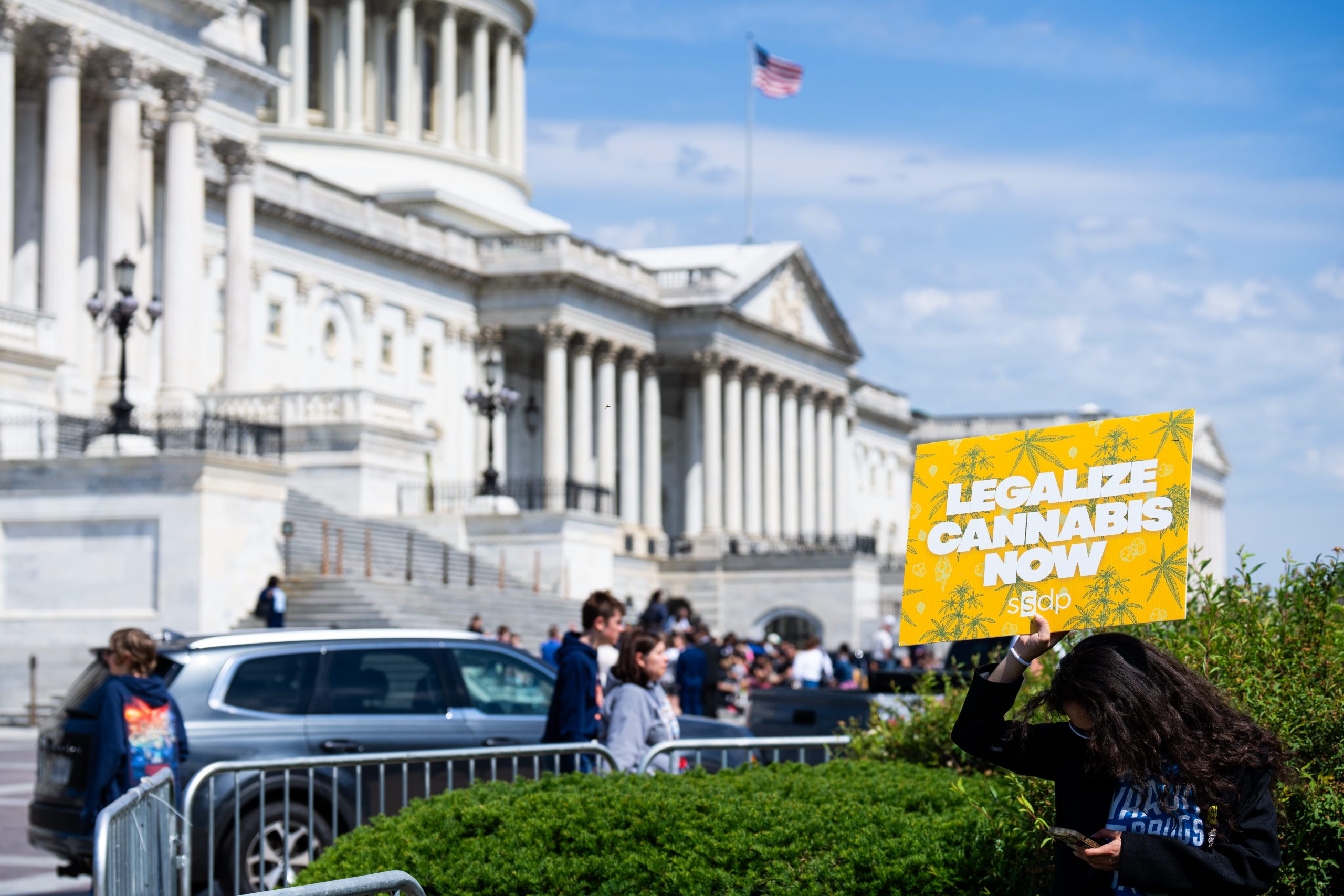
Marijuana has swung between acceptance and prohibition in the United States for decades. Since 1996, 40 states and the District of Columbia have legalized medical or recreational adult use cannabis. Yet the plant remains a Schedule I drug under federal law, as defined by the Controlled Substances Act of 1970. With the November midterms approaching, cannabis policy is once again emerging as a point of debate for voters in both major parties.
Two states will vote on cannabis ballot measures in November: Massachusetts and Idaho. Gubernatorial races in Kansas and Iowa are also featuring marijuana as a talking point. While cannabis may not rank with the economy, immigration, the war with Iran or AI data center construction in voters’ priorities, the issue is likely to remain on the radar for both Democrats and Republicans.
Morgan Fox, political director for NORML, a nonprofit group that advocates for cannabis legalization, said the issue has broad appeal. “It’s certainly a very popular issue among voters,” he said. “It’s possible that it could become a more important issue as we get closer to the midterms, particularly if Republicans are worried about losing one or both chambers.”
President Donald Trump drew attention to the matter in December 2025, when he urged the Justice Department to speed up moving marijuana from Schedule I to Schedule III, a category that also includes Tylenol with codeine, ketamine and testosterone. The timing, coming alongside the administration’s directive to fast track approval of psychedelic drugs and Trump’s declining approval rating, could be seen as an attempt to motivate Republican voters who support looser drug laws. It also undercuts Democrats, who failed to reschedule cannabis while Joe Biden was president.
In April, Acting Attorney General Todd Blanche signed an order to place state licensed medical marijuana into Schedule III, easing research restrictions and federal tax burdens for businesses in the $30 billion legal cannabis industry. In what appeared to be a nod to voters, outgoing White House press secretary Karoline Leavitt described the change as “overwhelmingly popular with the vast majority of Americans.”
A Gallup poll released in November found that 64 percent of U.S. adults believe marijuana use should be legal. That support, however, has slipped from 70 percent in 2023. The drop is especially noticeable among Republicans: support fell 13 points over the past year, from 53 percent to 40 percent, even as Trump has warmed to the industry. Democratic support has held at 85 percent and independents at 66 percent.
Kevin Sabet, CEO of Smart Approaches to Marijuana, a nonprofit that opposes legalization and commercialization, said that popularity may not translate into votes. He predicted cannabis reform will be a low priority come November. “It’s traditionally let down the politicians who thought they were going to be scoring some cheap votes,” he said, “most recently, the president.”
At the federal level, “cannabis will still be illegal,” Fox said, noting that the most concrete benefit of Schedule III is relief from IRS Section 280E, which prevents legal cannabis businesses from deducting standard expenses like payroll, rent and utilities. “280E has always been one of those things that you just have to operate around,” said Matthew Melander, president of Sun Theory, a vertically integrated cannabis company. “We know that if [it] does go away, that inherently makes the industry more profitable.”
Sabet conceded that removing 280E would benefit the industry. “I just don’t think it’s a good thing,” he said. “The last thing pot companies need are tax breaks.”
The prospect of rescheduling has energized Trump backers in the cannabis business who have lobbied the administration for changes. Kim Rivers, CEO of Trulieve, one of the country’s largest cannabis companies, donated $750,000 to Trump’s inauguration last year and attended a private $1 million per plate fundraiser at his New Jersey golf club, where she pushed for rescheduling and expanded medical cannabis research, according to the Wall Street Journal. Trulieve and other major operators, including Curaleaf, Green Thumb Industries and Verano Holdings, have put about $11.5 million into America First Agriculture Action Inc., a Trump aligned super PAC, according to Federal Election Commission filings.
Despite that support, many Republican lawmakers remain opposed to cannabis changes. More than 20 GOP senators and several House members have signed letters urging the White House to stop the reclassification. In August 2025, Representative Paul Gosar of Arizona wrote that rescheduling would not be “the boon to the Republicans’ midterm chances like Big Weed claims” and called it “a self-own for the Republican Party in 2026.”
Democrats in Congress have given the order a lukewarm reception, calling it a partial step short of full legalization. Last month, 17 Senate Democrats, led by Cory Booker, Chuck Schumer and Ron Wyden, reintroduced the Cannabis Administration and Opportunity Act for a second time. The legislation would remove cannabis entirely from the Controlled Substances Act and end federal prohibition. Wyden said in an email to CNBC: “Voters across the country have made it clear they want cannabis legalized, and Trump’s half measures aren’t fooling anyone.” He added that anything less than full descheduling is an attempt to boost Trump’s numbers before November, and that “The best path forward is passing” the CAOA.
The Democratic Party’s 2024 platform stopped short of endorsing federal recreational legalization or complete descheduling. The 2024 Republican platform took no clear position on cannabis legalization or rescheduling.
Marijuana has a long and contentious history. The Marihuana Tax Act of 1937 effectively criminalized cannabis, and “Reefer Madness” two years later worried parents across the country. Richard Nixon later signed the Controlled Substances Act, classifying marijuana as a Schedule I drug alongside heroin and LSD. Despite harsh federal and state anti drug laws in the 1990s, millions were arrested for possession and sale, and hundreds of thousands were incarcerated. In 1996, 75 percent of the public opposed legalization.
That year, California became the first state to legalize medical marijuana. Fifteen states have followed since. In 2012, Colorado and Washington became the first to legalize recreational adult use cannabis. Today, only Idaho and Kansas ban marijuana outright.
Idaho voters will decide in November whether to keep that ban. A ballot amendment would give the state legislature sole authority to prohibit citizen initiated ballot measures on marijuana, narcotics and psychoactive substances. An initiative to legalize medical cannabis failed to qualify for the ballot, despite nearly three quarters of surveyed voters supporting it.
Marijuana is not on the ballot in Kansas, but it is a topic in the governor’s race. Democratic candidate Cindy Holscher endorsed recreational legalization during her primary campaign. Her Republican opponent, state senate president Ty Masterson, opposes recreational legalization and has consistently blocked medical marijuana legislation.
In Iowa, where medical marijuana has been legal since 2017, the gubernatorial candidates are split. Republican Zach Lahn has said he would not support legalizing recreational marijuana, while Democrat Rob Sand announced in April a plan to “legalize, tax and regulate adult-use cannabis.”
Massachusetts faces a more unusual ballot measure. “An Act to Restore a Sensible Marijuana Policy” would keep the state’s medical marijuana program, approved in 2012, while repealing the 2016 vote that legalized recreational sales and cultivation, which passed 54 percent to 46 percent. If approved, it would be the first time a voter approved legalization measure is overturned.
Kevin Sabet, whose group SAM contributed to the effort, acknowledged the difficulty. “It’s a total uphill battle, definitely David and Goliath,” he said. “The marijuana industry can’t believe it qualified, but at the same time [is] mobilizing very strongly to get this to fail.”
State filings show the coalition behind the initiative received all of its $1.5 million in fundraising from SAM, with additional contributions expected in September. A group opposing the measure, “Stop the Repeal,” challenged the signature process but was denied by the State Ballot Law Commission.
Fox dismissed the measure’s chances. “It’s pretty clear that this is not something people actually want.” A University of New Hampshire poll from February found 63 percent of Massachusetts voters opposed, including 41 percent of Republicans. NORML plans to campaign against it. “We want to make sure that this thing goes down in flames,” Fox said.
With the November 3 election still months away, the importance of marijuana policy remains uncertain. Fox noted that supporters of reform are motivated to make their voices heard before then. The state initiatives and races, he said, show “a recognition that this is a politically popular issue.”